

When a company is looking to hire a young person, it typically values initiative, independence, digital skills, and the ability to adapt quickly. It is also common to encounter a requirement that is difficult to meet when one has not yet had a first job: prior experience.
This raises an obvious contradiction. How can a young person gain experience if they need to have it in order to get their first opportunity?
The issue is often addressed by referring to “young people” as if they all shared the same reality. However, being around the same age does not mean starting from the same place. At the same time, while many people are looking for an opportunity to apply what they know, numerous small and medium-sized businesses have accumulated small needs for improvement and digitization that they are unable to address due to a lack of time or internal capacity.
These two situations are usually analyzed separately, but perhaps they can be part of the same solution: turning real business challenges into opportunities for young people to learn, contribute, and demonstrate what they can do.
Not all young people start from the same place
Some young people graduate with specialized knowledge, language skills, professional contacts, and internship experience. Others face financial difficulties, family responsibilities, mobility issues, or a lack of guidance.
There are also differences related to place of residence, educational level, background, gender, disability, or access to technological resources. For some people, writing a resume, attending an interview, or navigating a professional environment comes relatively naturally because they have had role models close to them who have explained how a company works and what is expected of them. For others, their first encounter with the job market means entering a completely unfamiliar environment.

That is why, A poorly prepared application or a nervous interview does not always reflect a lack of interest or ability. Sometimes it simply indicates a lack of opportunities, guidance, and prior exposure to the professional world.
In addition to these differences, there is a circular barrier.
Companies value experience because it reduces uncertainty. Someone who has already worked in the field is familiar with certain dynamics, needs less time to adjust, and can demonstrate that they have applied their knowledge in a real-world setting.
The problem arises when that same experience is also required for entry-level positions. This does not mean that companies should eliminate their requirements or hire people who are not qualified. The challenge lies in creating opportunities that are appropriate for each candidate’s current stage in their career.
An inexperienced person can bring a willingness to learn, up-to-date knowledge, fresh perspectives, and familiarity with certain tools, but needs clear goals, manageable tasks, and guidance to help them get started.
Knowing something is not the same as having applied it
It’s also important to avoid another common misconception: being young does not automatically mean mastering the tools and dynamics of the professional world. Although many people use social media, mobile apps, or digital platforms on a daily basis, that does not necessarily mean they know how to organize information, analyze data, document a process, prepare a metric, or work with business tools. Therefore, these skills must also be learned and developed.
Furthermore, one of the best ways to do this is to apply them to a specific need. Learning to use a tool in an abstract way may have limited value; however, using it to solve a real problem allows for a better understanding of what it is for, what results it should produce, and how it fits into the functioning of an organization. In this way, learning ceases to be purely theoretical and becomes connected to a practical situation.
Furthermore, working on a specific case helps develop other important skills, such as organization, communication, independence, and accountability for results. The individual not only learns how to use a tool but also understands how to make decisions, solve problems, and adapt their knowledge to a company’s needs.
This difference is important because the job market values not only what a person knows, but also what they are able to do with that knowledge. Ultimately, an initial professional experience is much more valuable when it allows a person to demonstrate how they have applied what they have learned, what problem they have addressed, and what results they have achieved.
Turning real business needs into career opportunities
In many small and medium-sized businesses, there are improvement tasks that have been waiting for months. Organizing a set of documents, digitizing a checklist, structuring a record, reviewing a database, documenting a process, developing a metric, or replacing a manual task with a simpler workflow are examples of projects that can add value without requiring a complete transformation of the company
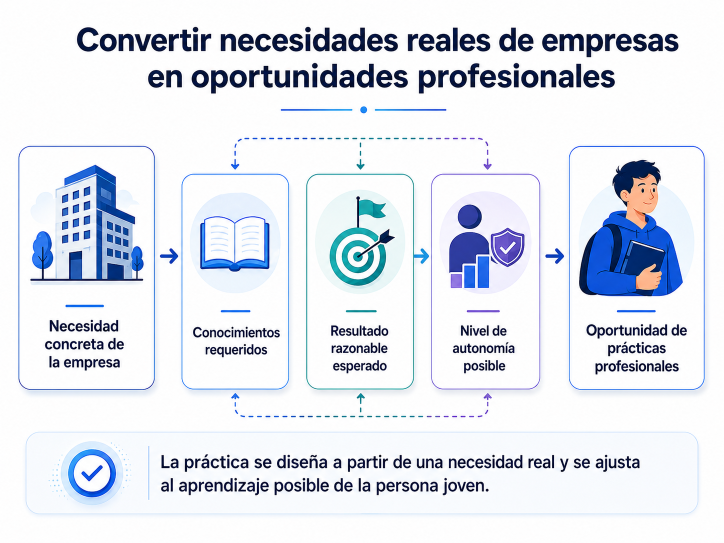
Taken separately, perhaps none of these projects would justify a new hire, but they can provide an excellent context for gaining initial professional experience. The key lies in changing the starting point: instead of first hiring a young person and then wondering what tasks they can perform, the company can begin by identifying a specific need and defining what problem it wants to solve, what results it hopes to achieve, what knowledge is required, and what level of autonomy and guidance will be necessary.
Based on that analysis, it becomes easier to determine whether the project is suitable for someone who is still building their career. The goal is not to assign them a critical problem or to let them work without guidance, but rather to offer them a real, well-defined, and manageable project in which they can learn, gradually take on responsibilities, and produce a result that benefits the company.
Prepare Before Bringing the Person On Board
This approach also helps prepare participants before they join the company. If the project involves digitizing a record, they can learn in advance how to structure the information and use the necessary tool. If they need to document a process, they can learn the basic principles for doing so beforehand. If they’re going to work with data, they can practice with similar examples before dealing with real information.
This way, the company isn’t taking on someone who is starting from scratch, and the young person isn’t entering an unfamiliar environment without knowing what is expected of them. Uncertainty is reduced for both parties, and the mentoring can focus on the specifics of the project and the company itself.
The level of difficulty should also be tailored to each participant’s background. Someone who is new to a company can start by observing and documenting a process. A participant with a technical background can take part in a simple digitization project, while someone with more experience can analyze information, develop metrics, or collaborate on more complex projects.
Not everyone needs to follow the same path or take on the same level of responsibility from the start. What’s important is that there be a reasonable balance between the challenge at hand, prior preparation, the expected level of autonomy, and the support available.
People would no longer have to limit themselves to saying that they know a tool or have studied a methodology. They could explain what problem they encountered, what work they did, and what results they achieved. Demonstrating applied knowledge is, in fact, one of the things companies look for when they ask for experience.
An opportunity must add value for both sides

Young people need to learn, gain confidence, and build a professional track record, while the company must receive a valuable contribution that justifies the time and resources devoted to the project.
A small, well-defined project can achieve both objectives. For the participant, this means addressing a real need, communicating with professionals, using business tools, and taking responsibility for an outcome. For the small business, it can mean making progress on an improvement that had been put off for months and meeting someone who, with the right training, can bring new skills to the team.
When these two needs come together in this way, the relationship between the parties also changes. The young person is no longer just someone who needs an opportunity but becomes someone capable of adding value. The company, for its part, can stop viewing the collaboration solely as a training effort and instead see it as a controlled way to tackle certain pending projects.
Matching a company with a young person, however, is still not enough. Someone must help identify suitable projects, prepare the participants, provide knowledge and tools, support the learning process, and ensure that the entire burden does not fall on the SME.
“Experience isn’t about having worked for many years. Experience is about having solved real problems.”
This is where educational institutions, social organizations, business associations, government agencies, companies, and specialized organizations can play complementary roles. The opportunity lies not only in connecting those who need experience with those who have work to be done, but also in creating the conditions for that collaboration to succeed.
There are young people who need a first opportunity to show what they can do, and at the same time, there are companies with pending projects that can’t find the time or resources to tackle them. The next challenge is to organize this meeting in a way that is useful, safe, and measurable for both parties.
Content written by:
Jordi Blanco Corrales, Co-founder and Product Manager at Kapture.io QMS
With more than 20 years of experience in the field of industrial quality, Jordi Blanco has witnessed the evolution of an industry characterized by continuous improvement, digitalization, and ever-increasing demands. His vision combines operational expertise, market insight, and technology to help organizations make better decisions and strengthen their competitiveness.