
In recent years, many industrial companies have adopted websites, cloud storage, ERP systems, virtual meetings, and all kinds of applications. From the outside, it may seem as though the digital transformation is already underway.
However, one need only take a closer look at day-to-day work to discover another reality: quality control forms that are still filled out on paper, incidents reported via email, multiple versions of the same document, and data that must be copied manually from one spreadsheet to another. This raises an uncomfortable but necessary question:
Are we dealing with a digital company, or simply a company that uses computers?
Digitization doesn’t always mean transformation
Replacing a piece of paper with a PDF can be helpful. Importing a record into Excel can also make certain tasks easier. But if people are still entering information manually, checking versions, and preparing reports at the end of the month, the process has hardly changed.
In fact, the opposite may happen: adding new applications may actually increase complexity. Each department uses its own tool, data is scattered, and no one has a complete picture of what is happening.
True digitization begins when it improves the way we work. A process is truly digitized when information is captured as soon as it is generated, there is a valid version of every document, responsibilities are clear, and data can be accessed without having to reconstruct it manually.
It’s not about doing the same thing in front of a screen. It’s about using technology to work better.
Many small and medium-sized businesses are halfway there
Most small and medium-sized businesses are not entirely untouched by digital transformation. They have taken significant steps forward, but they still rely on a mix of digital processes, spreadsheets, paper documents, and knowledge that depends on specific individuals.
Spain is a good example of this contradiction. According to the European Commission’s Report on the Digital Decade 2025, the country has a solid digital infrastructure that is, in general, more advanced than the European Union average. However, it continues to lag behind in the digitization of businesses, especially small and medium-sized enterprises (SMEs). The report also notes that the proportion of ICT specialists relative to total employment remains below the European average.
Data from the National Institute of Statistics show that the presence of technology does not necessarily imply a comprehensive transformation. In the first quarter of 2025, 99% of companies with ten or more employees had an internet connection, and 84.5% of connected companies had a website. However, only 44.3% used paid cloud computing services, and 21.1% employed artificial intelligence technologies.
In the industrial sector, adoption was even more moderate: 40.4% of industrial companies with ten or more employees used paid cloud computing services, and 17.5% used artificial intelligence. These figures alone do not describe how internal processes are organized, but they do show that there is a difference between having digital infrastructure and using advanced technologies effectively.
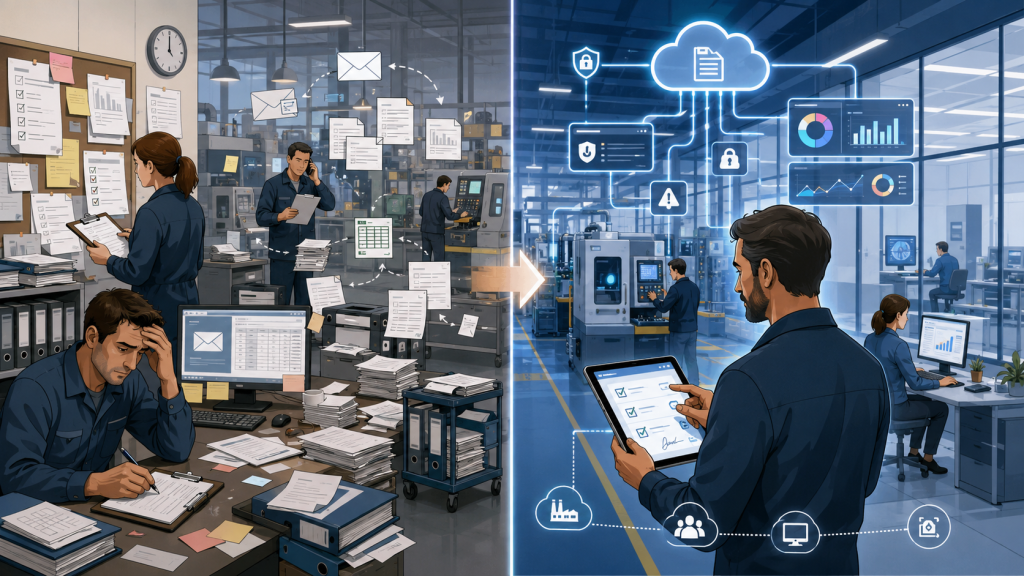
From Paper to True Digitization
Many companies do not make the leap directly from paper-based work to fully digitized processes. The transition usually occurs in stages: first, paper is replaced by spreadsheets; then, multiple Excel spreadsheets are used to track different activities; later, an ERP system is implemented; and, over time, various specialized applications are added.
Every step brings an improvement, but it can also create new problems. Data is scattered across different tools, duplicates appear, and certain processes continue to rely on manual tasks to link one data source to another.
True transformation occurs when these tools cease to function as isolated silos and become part of interconnected processes: information is entered only once, is available to whoever needs it, and can be used to make decisions without having to manually reconstruct it.
The economic barrier isn’t always the main one
When people talk about digitization, the conversation often centers on the cost of software, available financial assistance, or the necessary investment. All of these factors matter, but they do not fully explain why so many projects are delayed or fail to take root.
Public investment in digital transformation has been substantial. The Spanish roadmap outlined in the Report on the Digital Decade 2025 included 67 measures, with a budget of 33.8 billion euros, of which 26.7 billion came from public funding. Despite this effort, the European Commission continued to recommend paying special attention to the digitization of small and medium-sized enterprises (SMEs) and promoting the adoption of advanced technologies by businesses. (European Commission, 2025).
This finding reinforces an important point: while the availability of funding and tools is necessary, it is not sufficient. Transformation also depends on companies having the time, skills, leadership, and capacity to change their day-to-day processes.
One of the main barriers is a lack of time.
In an SME, the people who could drive improvement are the same ones who must resolve issues, handle audits, respond to customers, and keep production running. Digital transformation is important, but it rarely seems urgent. That’s why it gets put off for a week, then a quarter, and finally another year.
Buying a tool doesn’t guarantee change
Government grants have made it easier for many small and medium-sized businesses to access digital solutions. This is a positive step forward, but funding a license is not the same as funding a transformation.
A company needs more than just software. It needs to know where to start, define a reasonable scope, tailor the solution to its specific needs, train users, and provide support during the first few weeks of use.
When that support is lacking, the tool may end up being underutilized. In other cases, the company tries to digitize too many things at once, the project becomes complicated, and it ends up reverting to previous methods.
It is not usually a failure of technology. It is usually a problem of approach, implementation, and change management. For a long time, we have focused on providing tools. Perhaps now we should pay more attention to the skills needed to use them effectively.
Start small, but really start
Digital transformation doesn’t have to start with a massive project that affects the entire organization. In many cases, it’s more useful to identify a specific, recurring, and easily measurable problem.
For example, digitizing a control checklist, organizing a set of documents, improving the management of measuring instruments, or establishing a simple workflow for nonconformities. The key is that the change produces a visible benefit.
Replacing a paper-based process with a digital form is of little value if someone then has to download the data and prepare the report manually. Real progress occurs when the information is stored automatically, deviations trigger alerts, and those in charge can view the results in real time. A small project can serve as a way to learn, identify errors, engage users, and demonstrate that change is possible without disrupting operations. The first step doesn’t have to transform the entire company. It should reduce uncertainty and build confidence to tackle the next one.
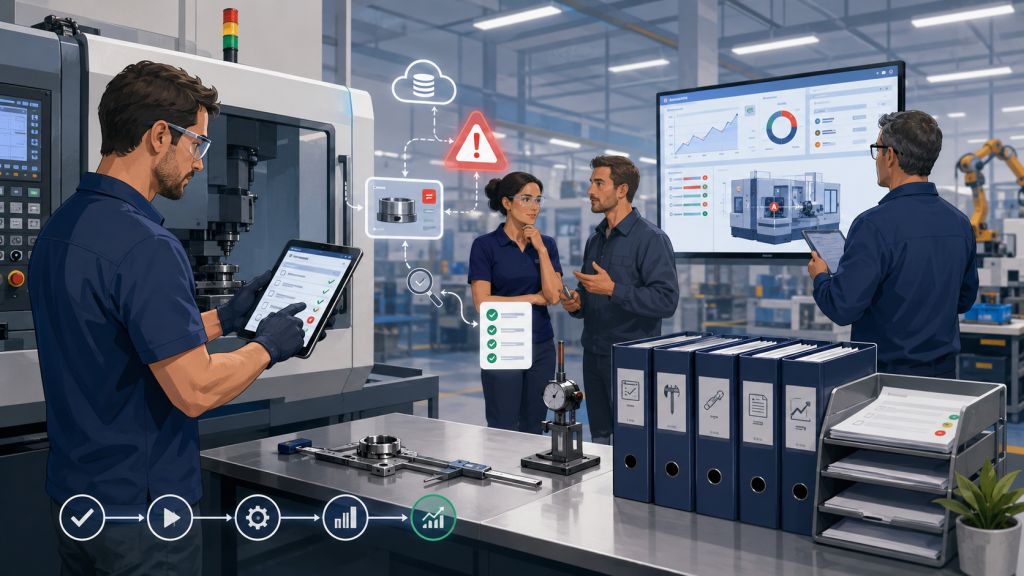
The new ISO 9001:2026 also promotes more interconnected processes
This need to move from isolated tools to truly connected processes is also evident in quality management. The new ISO 9001:2026, scheduled for publication on September 16, comes at a time when organizations are increasingly managing information, metrics, changes, suppliers, and evidence digitally.
For a company, complying with a quality management system means being able to demonstrate that information is controlled, that changes are traceable, that responsibilities are defined, and that process results are analyzed to inform decision-making and drive improvement. The larger the organization or the more complex its quality system, the more difficult it is to maintain that level of control using scattered documents, spreadsheets, and manual tasks.
The very approach of the ISO 9001 Auditing Practices Group already takes into account scenarios in which documented information is part of ERP systems, software, and digital workflows. This reflects a significant shift: the quality system no longer needs to be viewed as a set of independent procedures and records, but rather as a network of processes, data, and evidence that must remain interconnected and accessible.
The ISO 9001 review can thus become a good opportunity for companies not only to review procedures, but also to ask themselves how they are actually managing quality information. Knowing which version of a document is current, verifying who approved a change, tracking a nonconformity through to its corrective action, or reviewing the trend of an indicator should be a natural part of the process—not something that requires manual reconstruction every time that information is needed.
Technology does not replace the management system. It makes it possible to transform that system into something more traceable, accessible, and integrated with the organization’s day-to-day operations. And that is precisely the difference between using digital tools and having truly digitized a process.
The technology exists; what’s missing is the ability to apply it
Industrial SMEs have no shortage of problems to solve. There are duplicate documents, manual records, spreadsheets that have grown out of control, and administrative tasks that take up many hours. Nor is there a shortage of technologies capable of helping.
What is often lacking is the ability to turn those needs into manageable projects: people who can analyze a process, organize the information, propose a realistic solution, and support the team during implementation.
Some of these needs can also become opportunities for new professionals to gain experience by working on real-world problems. This connection between the unmet needs of small and medium-sized businesses and people seeking their first professional opportunity.
The remaining challenges of digital transformation will not be solved simply by purchasing more software. They will be solved by creating the conditions that allow companies to use, adapt, and integrate it into their daily operations. Because a company does not transform itself simply by installing a new tool. It makes a difference when people start performing better because of it.
Bibliographic References
- European Commission.Country Report on Spain for the Digital Decade 2025. Published on June 18, 2025. It supports the assertions regarding Spain’s strong digital infrastructure, the lag in business digitization, and the lower proportion of ICT specialists.
- National Institute of Statistics.Survey on the Use of ICT and E-Commerce in Businesses. 2024–First Quarter of 2025 . Published on October 22, 2025. It provides data on connectivity, websites, the cloud, artificial intelligence, and differences across sectors.
- European Commission.Country Report on the Digital Decade 2024 in Spain. This can be used to provide comparative context: in 2023, 27.2% of Spanish companies used cloud services, compared with an EU average of 38.9%; ICT specialists accounted for 4.4% of employment, compared with 4.8% in Europe.
- International Organization for Standardization (ISO).ISO 9001 — Quality management systems — Requirements. Official status of the sixth edition of ISO 9001, currently in the process of being published and scheduled for September 2026.
- https://www.iso.org/standard/9001 ISO/TC 176/SC 2. ISO 9001 revision update . Published on August 7, 2026. Confirms the approval of ISO/FDIS 9001 with broad international support and indicates September 16, 2026 as the expected publication date of the sixth edition.
- https://committee.iso.org/sites/tc176sc2/home/news/content-left-area/news-and-updates/news-1.html ISO 9001 Auditing Practices Group / International Accreditation Forum. Guidance on: Auditing Digital Processes . Guidance document on auditing digital processes and incorporating documented information into software, ERP, workflows, and other digital systems. ISO itself clarifies that these documents constitute guidance and are not additional requirements of ISO 9001.
- https://committee.iso.org/files/live/sites/tc176/files/PDF%20APG%20New%20Disclaimer%2012-2023/ISO-TC%20176-TF_APG-Digital_Processes.pdf
Content written by:
Jordi Blanco Corrales, Co-founder and Product Manager at Kapture.io QMS
With more than 20 years of experience in the field of industrial quality, Jordi Blanco has witnessed the evolution of an industry characterized by continuous improvement, digitalization, and ever-increasing demands. His vision combines operational expertise, market insight, and technology to help organizations make better decisions and strengthen their competitiveness.