
- What is quality control in consumer goods?
- Why is quality control critical for consumer products?
- What are the current challenges regarding quality in consumer goods?
- Should we control quality or build quality into the process?
- What does digitizing quality control for consumer goods entail?
- How does a QMS improve quality in consumer goods?
- Real-world applications in consumer products
- How Can We Improve Quality Control in the Consumer Goods Industry?
- Frequently Asked Questions
What is quality control in consumer goods?
Quality control in consumer goods refers to the set of processes, methods, and checks applied during manufacturing to ensure that products meet technical specifications, functional requirements, and safety standards before reaching the end customer.
In high-volume production environments, such as those for household appliances, white goods, or consumer electronics, this control not only validates the finished product but also manages process variability to prevent defects at their source.
Unlike other industrial sectors, quality here has a direct impact on the user experience. A defect is not just a technical flaw—it can lead to a return, a complaint, or a loss of trust in the brand. For this reason, quality control in the manufacturing of consumer goods cannot be limited to final inspections but must be integrated throughout the entire production process.
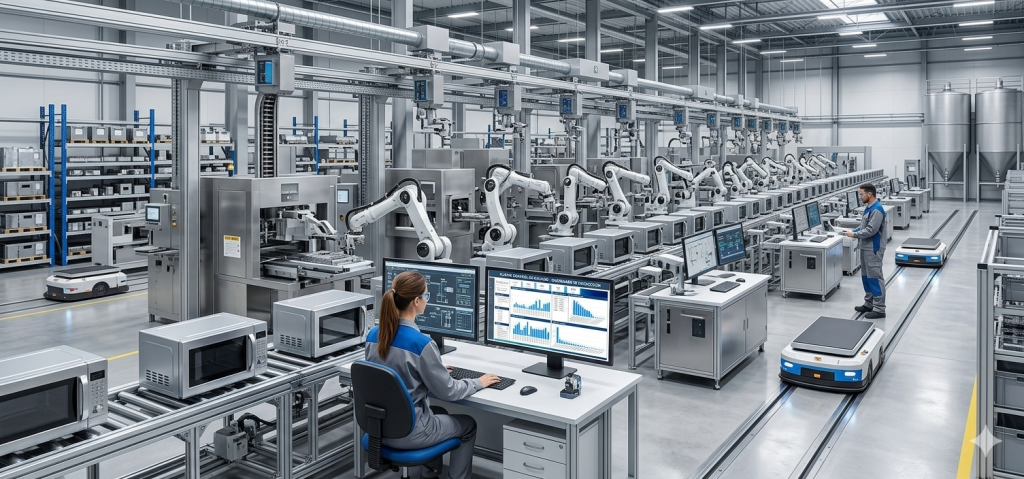
Why is quality control critical for consumer products?
In the manufacturing of consumer goods, quality is not an optional attribute. It is a key factor in a company’s competitiveness and sustainability. Unlike other industrial sectors where customers may tolerate certain tolerances or variations, the standards for consumer products are much more stringent. The product must function properly from the very first use, with no visible errors.
This has several implications:
- The impact on the customer is immediate. A defect in a household appliance or electronic device does not go unnoticed. It leads to returns, complaints, and, in many cases, a loss of customer loyalty.
- The cost of the error multiplies. It involves not only scrap or rework on the production floor, but also reverse logistics, warranty management, and after-sales service. In high-volume scenarios, even small failure rates can result in significant losses.
- The brand’s reputation is at stake. In saturated markets, perceived quality is one of the key differentiators. An inconsistent product can directly affect the company’s image.
That is why quality control for consumer goods must go beyond basic compliance. It must ensure consistency, traceability, and the ability to respond to any deviations.
What are the current challenges regarding quality in consumer goods?
Quality management in the manufacturing of consumer goods faces a more demanding environment than ever before. Companies must produce faster, at lower costs, and while maintaining increasingly high standards.
One of the main challenges is mass production. As quantities increase, so does the likelihood of variability. Maintaining consistency across thousands or millions of units requires a much more structured and precise control process.
Added to this is the increasing complexity of products. Today’s consumer goods incorporate multiple components, assembly processes, and technologies that increase the number of potential points of failure. Every interaction between parts introduces a new variable that must be controlled.
Another significant challenge is cost pressure. Companies are seeking to optimize their processes without compromising quality, which requires them to make more precise decisions and reduce margins of error.
In addition, production cycles are becoming shorter and shorter. Time-to-market is decreasing, and the ability to respond to problems must be immediate. This limits the effectiveness of traditional models based on periodic reviews or post-hoc checks.
Added to all this is a structural limitation that remains present in many organizations. Quality management continues to rely on fragmented systems, with information scattered across different departments and limited capacity for real-time analysis. This makes it difficult to identify root causes and turns quality management into a reactive and slow process.
Should we control quality or build quality into the process?
One of the most important changes in modern quality management is the realization that it is not enough to simply check the result. Quality must be built into the process. Quality control involves verifying whether or not the product meets specifications. It is a post-production activity that acts on the final result. Although necessary, it often comes too late—after the defect has already occurred and the cost has already been incurred.
Building quality, on the other hand, involves taking action during the process to prevent defects from occurring. It means defining clear parameters, controlling critical variables, and ensuring that each operation is performed under the correct conditions. In the manufacturing of consumer goods, this difference is particularly significant. The speed and volume of production mean that errors spread quickly. If the problem is not detected at its source, it can affect large quantities of product in a short amount of time.
That is why the most competitive companies in this sector do not focus solely on inspection, but rather on continuously monitoring the process. They use data to understand variability, standardize operations, and establish mechanisms that allow them to detect deviations as soon as they occur.
This approach transforms quality from a final-stage control function into a system integrated into the operation itself, which identifies and prevents problems.

What does digitizing quality control for consumer goods entail?
Digitizing quality control doesn’t simply mean replacing paper with a screen. It involves transforming the way data is captured, managed, and used within the operation.
- The centralization of information. All quality records are now stored in a single system, which allows for immediate access and prevents inconsistencies between different sources.
- Capturing data at the point where it is generated. Operators enter information directly as processes are carried out, which improves accuracy and reduces the need for subsequent data entry.
- Real-time availability. Information is no longer historical; it becomes operational. This makes it possible to detect deviations as soon as they occur and take action before they have an impact.
In addition, digitization facilitates traceability. Each data point is linked to a specific context, such as a batch, line, shift, or product code. This makes it possible to reconstruct the entire process and analyze the causes of any problem with greater clarity. Finally, it enables more advanced analysis. By consolidating information, it is possible to identify patterns, evaluate process performance, and guide improvement decisions more precisely. Overall, digitizing quality transforms quality control from a one-off process into a continuous, connected system.
How does a QMS improve quality in consumer goods?
A quality management system, or QMS, makes it possible to implement this digitization at the operational level. It is not just about managing information, but about structuring quality control within the production workflow.
In the manufacturing of consumer goods, where volume and speed are critical, a QMS helps standardize processes and ensure that each operation is carried out under defined conditions. This reduces variability and improves the consistency of the final product. It also facilitates the timely implementation of controls. Checks are no longer dependent on memory or individual experience; instead, they become an integral part of the process. This ensures that they are always performed under the same conditions and using the same criteria.
Another key aspect is visibility. By centralizing information, it provides a clear understanding of what is happening on the factory floor. This makes it easier to identify problems, prioritize actions, and track results. In addition, it improves coordination between departments. Production, quality, and maintenance all work with the same information, which reduces inconsistencies and allows for more aligned decision-making.
In this environment, quality control ceases to be a separate activity and becomes integrated into operations as a continuous process.
Real-world applications in consumer products
In all these cases, the goal is the same: to detect deviations as early as possible, understand their causes, and ensure that they do not recur.
How Can We Improve Quality Control in the Consumer Goods Industry?
Improving quality control in the manufacturing of consumer goods does not necessarily require a complete overhaul right from the start. The important thing is to establish a solid foundation that allows for gradual improvement.
- The first step is to identify the critical points in the process. Not all controls have the same impact on product quality. Prioritizing those that directly affect functionality or the user experience leads to faster results.
- Next, it is necessary to analyze how data is being managed. Assess whether the information is recorded manually or digitally, whether it is consistent, whether there is sufficient traceability, and whether the data is easily accessible when making decisions.
- Another important aspect is to review how controls are carried out. Ensure that they are performed at the appropriate time, according to defined criteria, and consistently across shifts and production lines.
From there, the adoption of digital tools such as Kapture.io QMS enables us to improve efficiency, digitize records, integrate information, and work with real-time data. This approach allows for controlled evolution without disrupting operations, while ensuring continuous improvement in quality management.