Find out your level of digital maturity.

Take our questionnaire and receive an initial diagnosis to identify your level of digitalization, which quality processes you should prioritize, and what impact they could have on your operations.

Digital Maturity Assessment

Identify where control is lost before setting priorities.

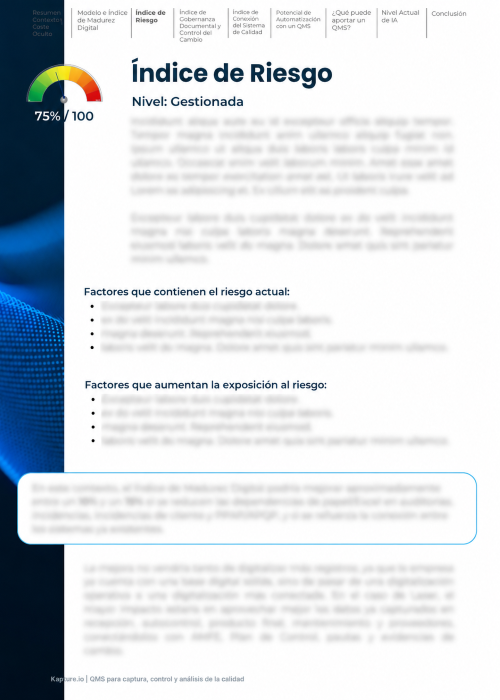
The diagnosis helps you identify your level of digital maturity, your level of risk exposure, potential for automation, and opportunities for improvement before deciding which process to digitize first.
Document Risk Icon

Documentary Risk

Identify critical situations in FMEA, control plans, guidelines, and evidence that may affect quality.

Traceability and Data Icon

Traceability and Data

Assess the availability and quality of your quality records, and to view evidence, batches, and processes.

Digitization Priority Icon

Digitalization Priorities

Get an initial diagnosis to determine which processes you should review first, based on your operational context.

How prepared is your company for industrial quality over the next five years?

Receive a free 10–15-page diagnosis containing information such as:

  • Digital Maturity Index
  • Comparison with similar companies
  • Level of risk exposure
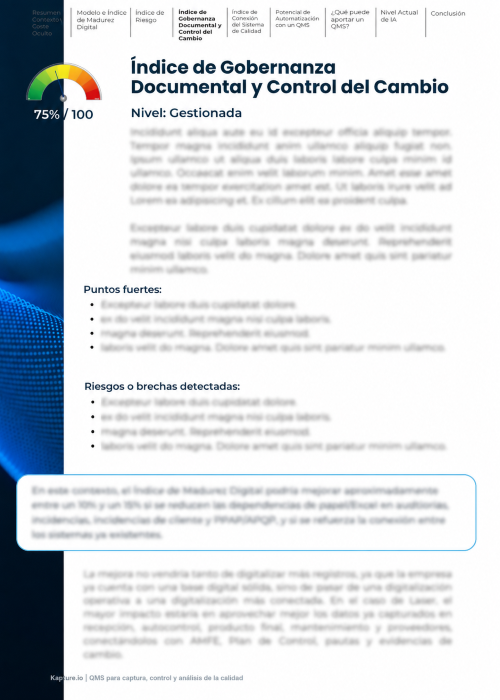
  • Document governance and change control
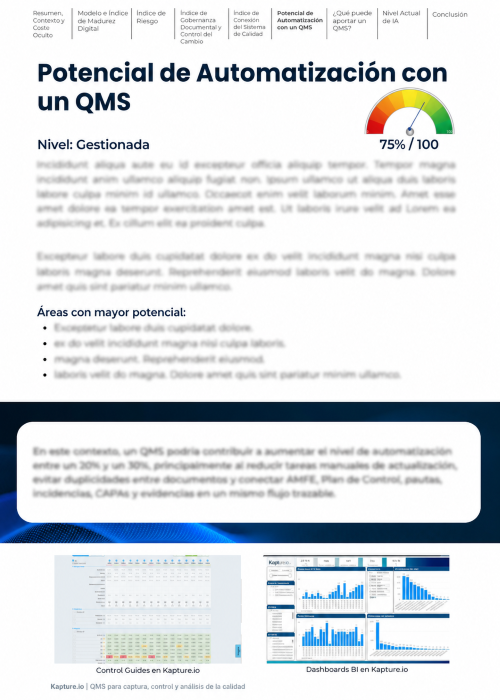
  • Automation potential
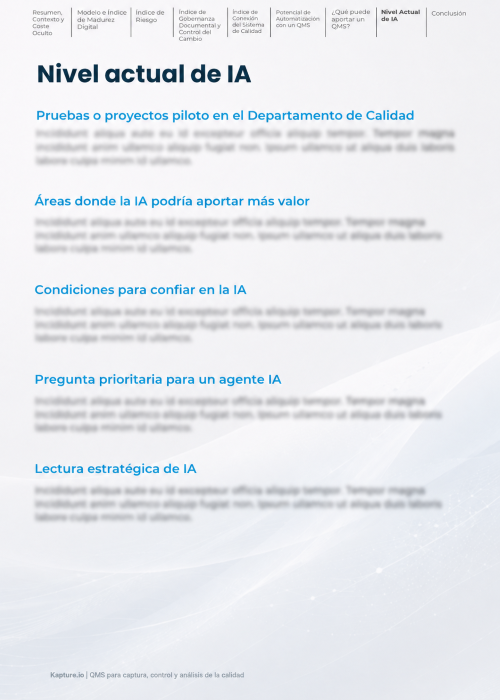
  • How AI can support quality
I want to receive my diagnosis
Kapture.io

Tell us how you currently manage quality on the shop floor

  • Discover how much hidden risk exists in your quality document management.
  • Calculate your risk exposure from engineering changes.
  • Estimate the cost of keeping FMEAs, control plans and inspection instructions synchronised.

Answer these questions and receive a free initial diagnosis within 48 hours*. The questions will help us understand the context and your area of work, measure your digital maturity and where you want to take your organisation, as well as estimate your risk exposure, document governance, change control and automation potential based on the number of references and the management complexity of your system.

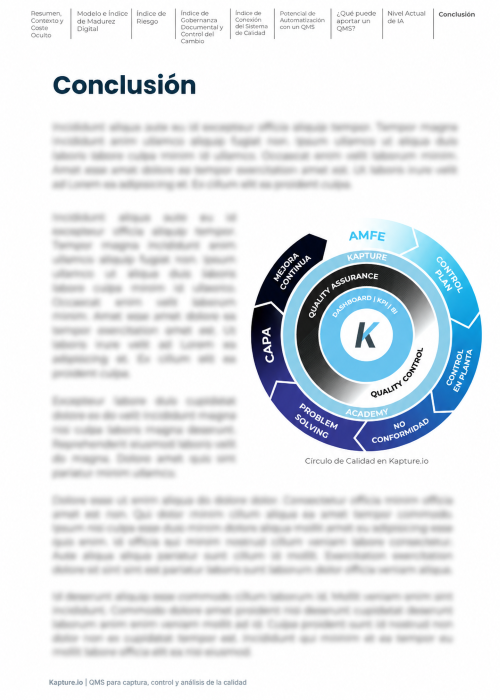
Kapture.io quality circle

*Receive your initial diagnosis by email within 48 working hours.

Question 1 of 38 0%
Diagnosis baseline
Question 1

Which aspects of quality management would you currently like to review or improve?

This helps us understand which areas you want to prioritise and how we can better focus the initial diagnosis.

Instructions: Select one or more options as appropriate.

Add an optional note
Diagnosis baseline
Question 2

Which quality certifications does your company work with?

This helps us better understand your document control requirements, traceability and audit readiness.

Instructions: Select one or more options as appropriate.

Add an optional note
Diagnosis baseline
Question 3

Which industry or industries does your company operate in?

Your industry allows us to tailor the diagnosis to your operational, regulatory and quality context.

Instructions: Select one or more options as appropriate.

Add an optional note
Operational complexity
Question 4

Approximately how many active references do you manage?

This answer helps us understand your operational complexity and the level of risk associated with quality management.

Instructions: Select the option that best applies.

Add an optional note
Operational complexity
Question 5

Approximately how many product or process changes do you manage each year?

The more changes you manage, the greater the potential risk of inconsistencies, rework or outdated documentation.

Product change: a modification to product characteristics that may affect its functionality, quality, safety or reliability.

Process change: a modification to how the product is manufactured, assembled, inspected or controlled.

Instructions: Select the option that best applies.

Add an optional note
Operational complexity
Question 6

How many active FMEAs do you currently manage?

This helps us assess document complexity and the need to connect FMEAs, control plans and inspection instructions.

Instructions: Select the option that best applies.

Add an optional note
Document maturity
Question 7

How are FMEAs, control plans and inspection instructions updated when a design or process change is approved?

This answer provides key information about document maturity and integration between critical documents.

Instructions: Select one or more options as appropriate.

Add an optional note
Document maturity
Question 8

When a product or process change occurs, how long does it usually take to update the related documentation?

The update time helps measure the risk of working with incomplete information or inconsistent versions.

Instructions: Select the option that best applies.

Add an optional note
Document maturity
Question 9

How often do you need to review alignment between FMEAs, control plans and inspection instructions?

This answer helps us understand how consistency is maintained across critical quality documents.

Instructions: Select the option that best applies.

Add an optional note
Document maturity
Question 10

When a significant non-conformity is managed, how long after the action is closed does it usually take to update the related documents?

This answer helps assess how quickly documentation is updated following significant quality incidents.

Instructions: Select the option that best applies.

Add an optional note
Data capture and traceability
Question 11

Which quality records do you currently manage, and in what format?

This helps us understand which processes already exist, how they are recorded and where the greatest opportunities for digitalisation may lie.

Instructions: Select how each type of record is currently managed. You may select more than one option per row. N/A = Not applicable.

Incoming inspection
Process / self-inspection
Final product
Audits
Incidents
Maintenance
Supplier inspections
Customer incidents
PPAP / APQP
Add an optional note
Data capture and traceability
Question 12

Which quality processes would make the most sense to digitalise first?

Understanding these priorities helps us better focus the initial diagnosis and the recommended next steps.

Instructions: Assign a priority number to each area. You may use the same number for several options if they are equally important. 1 = Highest priority. 5 = Lowest priority. N/A = Not applicable.

FMEA and control plan
Inspection instructions
Measuring instrument and equipment management
Incoming material inspection
Quality walls
Incident and non-conformity management
Problem solving
Corrective and preventive actions
Audits and continuous improvement
Add an optional note
Data capture and traceability
Question 13

Can you locate all inspections associated with a batch in under 5 minutes?

This answer helps measure operational traceability and how quickly evidence can be retrieved for incidents or audits.

Instructions: Select the option that best applies.

Add an optional note
Data capture and traceability
Question 14

Do you have traceability between raw materials, processes and finished products?

Traceability between materials, processes and finished products is essential for identifying causes, containing incidents and responding to customers or auditors.

Instructions: Select the option that best applies.

Add an optional note
Integration and automation
Question 15

Which systems are currently connected to quality management?

This answer helps assess the current level of integration between quality and other operational or management systems.

Instructions: Select one or more options as appropriate.

Add an optional note
Integration and automation
Question 16

How do you currently manage data capture across different systems or records?

This answer helps us understand whether quality information is captured once or still duplicated across different systems, files or records.

Instructions: Select the option that best applies.

Add an optional note
Operational quality risk
Question 17

When a change is approved, how many documents usually need to be reviewed or updated?

This answer helps estimate how complex it is to keep documentation aligned when product, process or design changes occur.

Instructions: Select the option that best applies.

Add an optional note
Operational quality risk
Question 18

How many people are usually involved in updating quality documentation?

A greater number of people involved may increase the likelihood of errors, delays or inconsistent versions.

Instructions: Select the option that best applies.

Add an optional note
Operational quality risk
Question 19

How often do you need to correct documented information because of discrepancies, versions or incomplete data?

This answer helps estimate document-related risk exposure and the impact of manual or poorly connected processes.

Instructions: Select the option that best applies.

Add an optional note
Operational quality risk
Question 20

When a document discrepancy occurs, what impact does it usually have on operations?

This question identifies the operational impact of document discrepancies, from internal rework to effects on audits, complaints or associated charges.

Instructions: Select one or more options based on your current situation.

Add an optional note
Document maturity and change management
Question 21

When a procedure is changed, how is version control managed within the company?

This helps us understand whether document changes are traceable and whether there is visibility of the current version, what was changed and who made each change.

Instructions: Select one or more options based on your current situation.

Add an optional note
Document maturity and change management
Question 22

Before a document is published, how is its approval managed?

This question identifies whether documents undergo a formal review before they are made available to quality, production or operations teams.

Instructions: Select one or more options based on your current situation.

Add an optional note
Document maturity and change management
Question 23

How does the company ensure that operators use the latest version of a document?

The aim is to understand how current documents are controlled on the shop floor and whether teams risk working with outdated or unapproved versions.

Instructions: Select one or more options based on your current situation.

Add an optional note
Document maturity and change management
Question 24

When a procedure changes, how is the associated training communicated and recorded?

This allows us to assess whether document changes reach the people involved and whether there is evidence that the new procedure has been read, understood or covered in training.

Instructions: Select one or more options based on your current situation.

Add an optional note
Document maturity and change management
Question 25

When an auditor requests evidence, how is it located within the company?

This question helps us understand the level of traceability between documents, processes, records, batches and the evidence required during an audit.

Instructions: Select one or more options based on your current situation.

Add an optional note
Document maturity and change management
Question 26

When a document changes, which actions are reviewed or triggered as a result?

This helps identify whether document changes are managed in isolation or whether their impact on other documents, instructions, FMEAs, control plans or operating instructions is also reviewed.

Instructions: Select one or more options based on your current situation.

Add an optional note
Document maturity and change management
Question 27

When a procedure changes, who verifies that the change has been correctly implemented on the shop floor?

This question assesses whether document changes have genuinely been communicated, understood and applied by the people working directly in the process.

Instructions: Select one or more options based on your current situation.

Add an optional note
Non-conformities, CAPA and change propagation
Question 28

When a non-conformity is detected, what usually happens after it is recorded?

This question helps determine whether non-conformities are managed as isolated events or trigger a broader review, including containment, analysis, corrective actions and document updates.

Instructions: Select one or more options based on your current situation.

Add an optional note
Non-conformities, CAPA and change propagation
Question 29

When an FMEA is changed, which other elements are reviewed or updated as a result?

This helps assess whether changes in risk analysis are correctly carried through to operational controls, inspection instructions and related documentation.

Instructions: Select one or more options based on your current situation.

Add an optional note
Non-conformities, CAPA and change propagation
Question 30

Which elements are the company's inspection instructions currently linked to?

The aim is to understand whether inspection instructions operate as standalone documents or are connected to key process elements such as FMEAs, control plans, products, machines, instruments or operators.

Instructions: Select one or more options based on your current situation.

Add an optional note
Non-conformities, CAPA and change propagation
Question 31

When a control plan changes, how are the related inspection instructions updated?

This question identifies whether there is a controlled relationship between the control plan and shop-floor instructions, or whether changes depend on notifications, manual reviews or separate updates.

Instructions: Select one or more options based on your current situation.

Add an optional note
Non-conformities, CAPA and change propagation
Question 32

When a customer incident is recorded, which elements is it linked to?

This allows us to assess traceability, particularly whether the incident can be linked to a non-conformity, batch, completed inspections or the corresponding FMEA.

Instructions: Select one or more options based on your current situation.

Add an optional note
Non-conformities, CAPA and change propagation
Question 33

Which elements are corrective and preventive actions linked to within the system?

This question helps determine whether CAPAs are managed as standalone actions or connected to non-conformities, audits, FMEAs, control plans, inspection instructions, training or equipment.

Instructions: Select one or more options based on your current situation.

Add an optional note
Non-conformities, CAPA and change propagation
Question 34

When a corrective action is approved, what happens next within the quality system?

This identifies whether the corrective action simply closes an incident or also triggers a document and operational review of inspections, the FMEA or the control plan.

Instructions: Select one or more options based on your current situation.

Add an optional note
Data, analysis and improvement
Question 35

In which quality processes do you think artificial intelligence could add the most value?

This question identifies the AI use cases perceived to have the greatest potential in quality, particularly for analysis, documentation, action prioritisation, information retrieval and decision-making.

Instructions: Select one or more options based on your current situation.

Add an optional note
Data, analysis and improvement
Question 36

Which condition do you consider most important for trusting a result generated by artificial intelligence?

This question helps us understand what the market expects from trustworthy AI applied to quality: explainability, traceability, security, accuracy, system integration and human oversight.

Instructions: Select one or more options based on your current situation.

Add an optional note
Data, analysis and improvement
Question 37

What stage has your company currently reached in its use of artificial intelligence in quality?

This question measures the current level of AI adoption in quality, from companies that have not yet considered it to those already using it in one or more processes.

Instructions: Select one or more options based on your current situation.

Add an optional note
Data, analysis and improvement
Question 38

What questions would you like to ask an AI agent about your own quality data?

This open question helps us identify the types of queries, analyses or decisions quality teams would like to address if they could interact with their own data using artificial intelligence.

Instructions: Optional response. You may enter one or more questions that you would like to ask an AI agent.

Receive your initial diagnosis by email

What will you receive?

An initial diagnosis outlining the next steps to consider for your project. We will respond within 48 working hours, so please keep an eye on your inbox.

We could not submit the form. Please check that Contact Form 7 is configured correctly.
✓

Request received

Thank you. We will review your answers and send your initial diagnosis by email within 48 working hours. Please keep an eye on your inbox.

Your initial diagnosis is based on:
1 Digital Maturity Index: current level of digitalisation, automation, integration and traceability.
2 Comparison with similar companies: benchmarking against organisations with comparable operational contexts.
3 Level of risk exposure: complexity, document volume, changes and potential operational impacts.
4 Document governance and change control: management of versions, approvals, document validity and change propagation.
5 Automation potential: opportunities to automate quality processes, traceability, evidence and documentation.
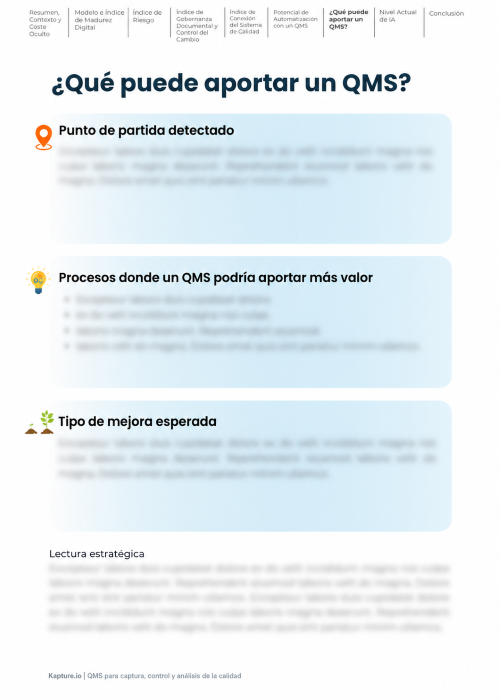
6 Prioritised recommendations: suggested actions to focus the next steps for improvement.

Why do we need 38 questions to prepare your diagnosis?

Because a useful assessment requires more than an overall score. The questions allow us to understand the context, complexity and how you currently manage quality before identifying risks, priorities and opportunities for digitalisation.

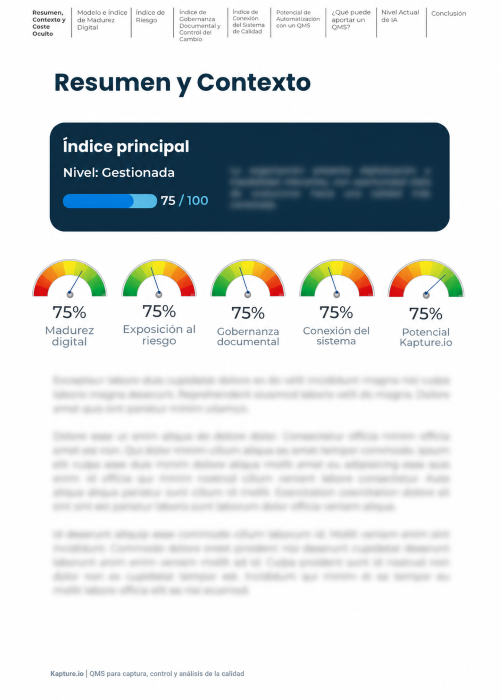
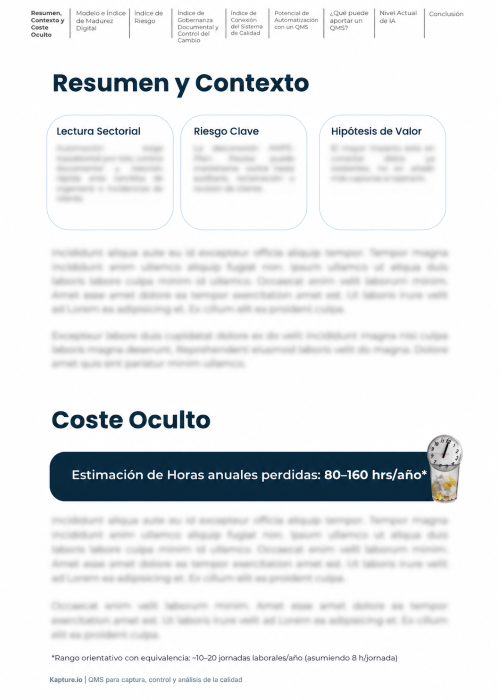
Summary and context of the initial Kapture.io assessment
Context

The same answer does not mean the same thing in every company.

The industry, certifications, number of references, volume of changes and existing systems all influence the interpretation. That is why we interpret the answers according to the reality of each operation.

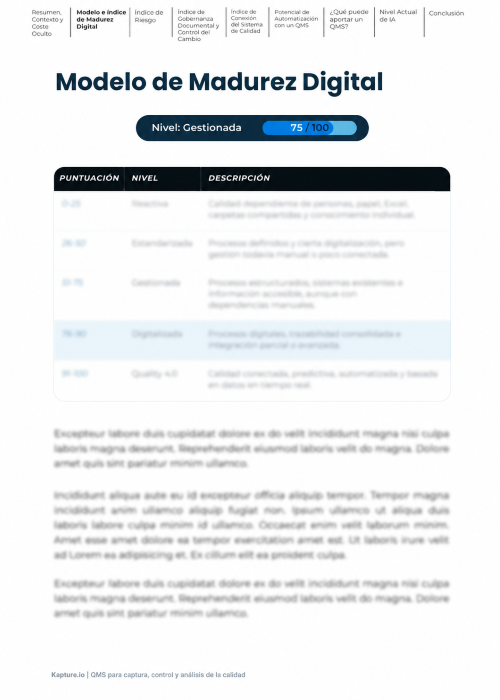
Digital Maturity Index included in the assessment
Indicators

We analyse different dimensions, not just your level of digitalisation.

  • Digital maturity
  • Risk exposure
  • Document governance
  • Quality system connectivity
  • Automation potential
  • Current level of artificial intelligence
Conclusion and priorities from the initial Kapture.io assessment
Guidance

The result should help you decide where to start.

The assessment connects the indicators with strengths, potential gaps and initial priorities, helping you continue your digitalisation journey with greater clarity, whether or not you implement a QMS.

The first step is not to implement more software. It is to know exactly where to begin.

Complete our form and receive an initial diagnosis to make informed progress in the digitalisation of your quality management.

I want my diagnosis
Scroll to Top