
The automotive industry is one of the most demanding manufacturing environments in terms of quality. Vehicle manufacturers and Tier 1, Tier 2, and Tier 3 suppliers operate under increasingly strict requirements to ensure that every component meets the defined specifications before reaching the assembly line.
In this context, managing processes such as APQP, FMEA, control plans, SPC, audits, corrective actions, or traceability using spreadsheets, separate documents, or offline applications increases the risk of errors, rework, and data loss.
Automotive QMS software allows all these processes to be centralized within a single platform, facilitating compliance with standards such as IATF 16949 and promoting more efficient, traceable quality management focused on continuous improvement.
In this article, you’ll learn what an automotive quality management system is, what features it should offer, and how it can help manufacturers and suppliers better control their production processes.

What is automotive QMS software?
Automotive QMS software is a platform designed to centrally manage all quality-related processes within an automotive company. Its goal is to ensure that every activity—from planning to product delivery—is carried out in accordance with internal requirements, customer standards, and regulations such as IATF 16949.
Unlike an ERP or a production system, a QMS specializes in controlling the processes that prevent defects, detect deviations, and ensure continuous improvement. Rather than simply storing documentation, it acts as the hub that connects the various quality activities carried out throughout the manufacturing cycle.
Depending on the solution implemented, QMS software can help manage processes such as the development of control plans, the conduct of on-site inspections, statistical monitoring using SPC, audit management, the management of corrective and preventive actions (CAPA), the traceability of products and materials, and the analysis of performance indicators.
The result is greater visibility into quality status in real time, a reduction in administrative work, and an increased ability to make decisions based on reliable data.
Why does the automotive industry need a digital quality management system?
The manufacture of automotive components requires a much higher level of control than in other industrial sectors. A small dimensional deviation, a recurring defect, or an incorrectly identified batch can affect thousands of parts and lead to customer complaints, recall campaigns, or high costs associated with quality issues.
At the same time, manufacturers and suppliers must continuously demonstrate compliance with the requirements established by customers and certification bodies. This requires maintaining complete records, traceable information, and thoroughly documented processes throughout the entire production cycle.
A quality management system for the automotive industry helps address these challenges by digitizing quality processes. By centralizing information, it reduces reliance on paper documents and makes it easier for all departments to work from a single source of data.
Among the main challenges that these types of solutions help address are:
- Maintain complete traceability of materials, processes, and finished products.
- Reduce scrap, rework, and nonconforming parts.
- Monitor metrics such as PPM and detect deviations before they reach the customer.
- Manage engineering changes without losing control of documentation.
- Facilitate internal, client, and certification audits.
- More efficiently meet the requirements of the IATF 16949 standard and the industry’s Core Tools.
Rather than simply replacing paper documents, QMS software provides a more structured, collaborative way of working based on real-time information. This allows for a faster response to incidents, reduces processing times, and provides greater control over the quality of the entire operation.
What should a company evaluate before choosing QMS software for the automotive industry?
Choosing high-quality automotive software should not be based solely on price or the number of available modules. What really matters is determining whether the platform can adapt to the plant’s workflow and support the processes required by the IATF 16949 standard and the industry’s Core Tools.
Here are some factors to consider before making a decision:
Processes That QMS Software Must Cover in an Automotive Plant
Quality management in the automotive industry involves much more than just final inspections. From product planning to customer delivery, there are numerous processes that must be kept in sync to ensure the conformity of every part manufactured.
QMS software allows you to integrate these processes into a single platform, preventing information from being scattered across documents, spreadsheets, or standalone applications. This makes it easier to track each activity, improves traceability, and reduces the time spent on administrative tasks.
Below are some of the processes that an automotive quality management system typically needs to cover.

When all these processes are managed from a single platform, the organization gains a much more comprehensive view of the state of quality and can respond more quickly to any issues.
How QMS Software Improves Every Stage of the Manufacturing Process
The value of QMS software lies not only in digitizing documents. Its main benefit is that it supports every stage of the production process, providing reliable information and facilitating real-time decision-making.
Essential Features of High-Quality Automotive Software
Every manufacturer has different processes, but there are certain features that virtually any automotive QMS software should include to meet the industry’s current needs.
- Digital inspection guidelines allow for the standardization of inspections by reference, machine, batch, or shift, ensuring that all operators perform the defined checks and record the information in a consistent manner.
- Statistical Process Control (SPC) helps monitor critical manufacturing variables and detect deviations before they result in nonconforming parts. This enables preventive action and significantly reduces the risk of generating large amounts of scrap.
- Automatic data capture from measuring instruments. Integrating gauges, comparators, measuring machines, or sensors prevents errors caused by manual data entry and speeds up the inspection logging process.
- Document management also plays a vital role. Always having the current version of procedures, work instructions, specifications, or control plans on hand reduces the risk of working with outdated documentation.
- Corrective and Preventive Action (CAPA) management allows you to track nonconformities from the time they are detected until the effectiveness of the implemented actions is verified, keeping all related information in one place.
- When it comes to audits, QMS software should facilitate the planning, execution, and follow-up of internal, customer, or certification audits, allowing users to record evidence, assign responsible parties, and monitor the progress of follow-up actions.
- Dashboards and metrics provide a consolidated view of quality status, allowing for the analysis of metrics such as PPM, FPY, scrap, incidents by line, inspection compliance, and supplier performance.
- The ability to integrate with ERP, MES, PLC, measurement systems, and other industrial applications via REST API or Webhooks is becoming increasingly important for avoiding duplication, improving data consistency, and connecting quality management with the rest of the operation.
Benefits of Implementing a QMS in the Automotive Industry
Implementing QMS software goes far beyond simply replacing paper documents. When quality information is centralized and processes are interconnected, the organization gains a greater ability to prevent incidents and continuously improve its operations.

Taken together, these benefits make it possible to build more stable processes, increase the capacity for prevention, and strengthen a culture of continuous improvement within the organization.
How Kapture.io Helps Manufacturers and Suppliers in the Automotive Industry
Kapture.io is QMS software designed to digitize quality management in industrial settings, helping manufacturers and suppliers centralize their quality processes on a single platform.
The solution enables users to manage digital control guidelines, perform inspections directly on the factory floor, monitor parameters using SPC, record nonconformities, track corrective actions (CAPA), plan audits, manage technical documentation, and consolidate quality metrics in real time.
In addition, it facilitates the traceability of products and processes, allowing inspections, batches, part numbers, equipment, and evidence to be linked within a single work environment. Thanks to its integration capabilities via REST API, Webhooks, and connections to other industrial systems, Kapture.io can exchange information with ERP, MES, and various tools used on the factory floor.
 Map of Defects
Alerts and Nonconformities
Map of Defects
Defectology Guidelines
- Map of Defects
Monitoring Guidelines
- Business Intelligence
Heat Map
- Control Plan
- Control Guides


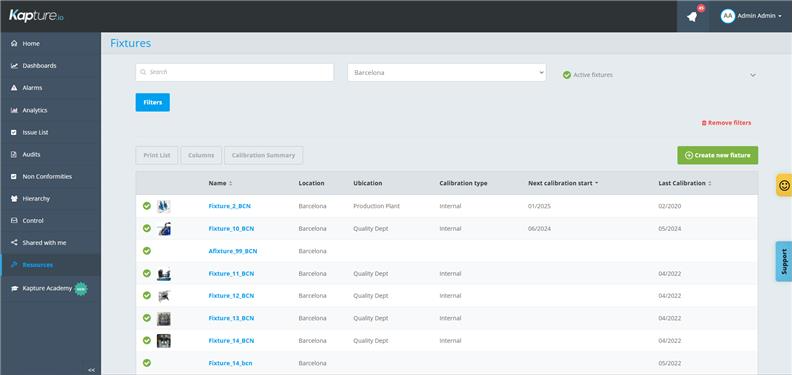


Unlike solutions focused exclusively on a single process, Kapture.io aims to connect the various quality-related activities to provide a comprehensive view of operations and facilitate continuous improvement.
Currently, the platform is already working with manufacturers and suppliers in the automotive sector, helping them digitize inspection, quality control, auditing, and data analysis processes within highly demanding production environments.
If your organization is looking for high-quality automotive software that can improve traceability, reduce manual tasks, and provide a unified view of quality, you can request a demo of Kapture.io and evaluate how to tailor it to the specific needs of your plant.