
In industrial digitization, one of the major challenges is properly connecting plant data with business management systems. Production, quality, engineering, maintenance, and operations all work with data that must be aligned to ensure traceability, efficiency, and control.
To achieve this, many industrial software solutions rely on international standards that enable the factory to be structured in a consistent manner. One of the most important is ISA-95, the benchmark standard for integration between enterprise systems and production control systems.
What is ISA-95?
ISA-95 is an international standard used in industrial environments to define how business systems, such as ERP, should be integrated with manufacturing operations systems, such as MES and MOM. In practice, ISA-95 helps connect systems such as:
- ERP systems, used for planning, purchasing, inventory, costs, or business management.
- MES, used to execute and control production on the shop floor.
- MOM, used to manage manufacturing operations more broadly.
- QMS, used to manage quality, controls, nonconformities, audits, or technical documentation.
- Industrial automation systems, such as PLCs, SCADA, HMIs, or DCSs.
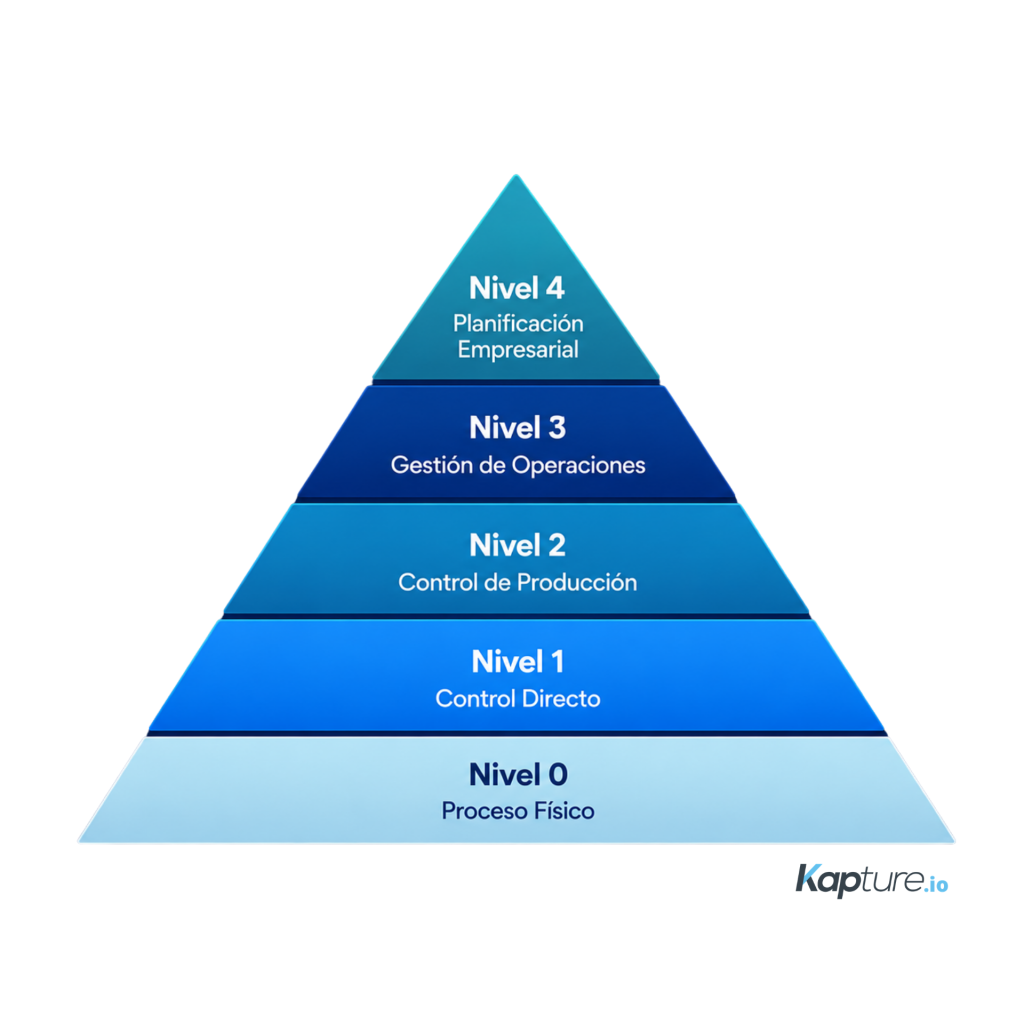
This standard provides a common model for organizing plant information, defining levels, hierarchies, and relationships among the various elements involved in production. Thanks to ISA-95, companies can structure their industrial data more clearly and facilitate communication between different systems, departments, and processes.
ISA-95 in MES and MOM Systems
MES (Manufacturing Execution System) and MOM (Manufacturing Operations Management) systems are essential for managing manufacturing operations in real time. These systems link planning with on-the-shop-floor execution, managing aspects such as production orders (POs), quality, operations, and work instructions, among others.
ISA-95 helps define how all this information should be organized so that the system can accurately represent the reality of the factory.
The Role of the QMS Within an ISA-95 Architecture
Although ISA-95 is typically associated primarily with integration between ERP, MES, and MOM systems, its application is also highly relevant for quality management systems, or QMS.
In an industrial setting, quality should not be managed as a separate layer from production. Controls, nonconformities, audits, technical documentation, and inspection records need to be linked to the reality on the shop floor: products, parts, operations, production lines, work centers, production orders, and resources used.
For this reason, an industrial QMS aligned with an ISA-95-type structure can provide much greater value than a traditional documentation system. Rather than simply storing procedures or records, it allows quality information to be linked to the operational context in which it is generated.
For example, a quality control check can be linked to a specific operation, a particular part, a production order, a production line, or a specific inspection plan. Similarly, a nonconformity can be associated with the actual process where it was detected, facilitating root cause analysis, traceability, and decision-making.
The Plant Hierarchy According to ISA-95
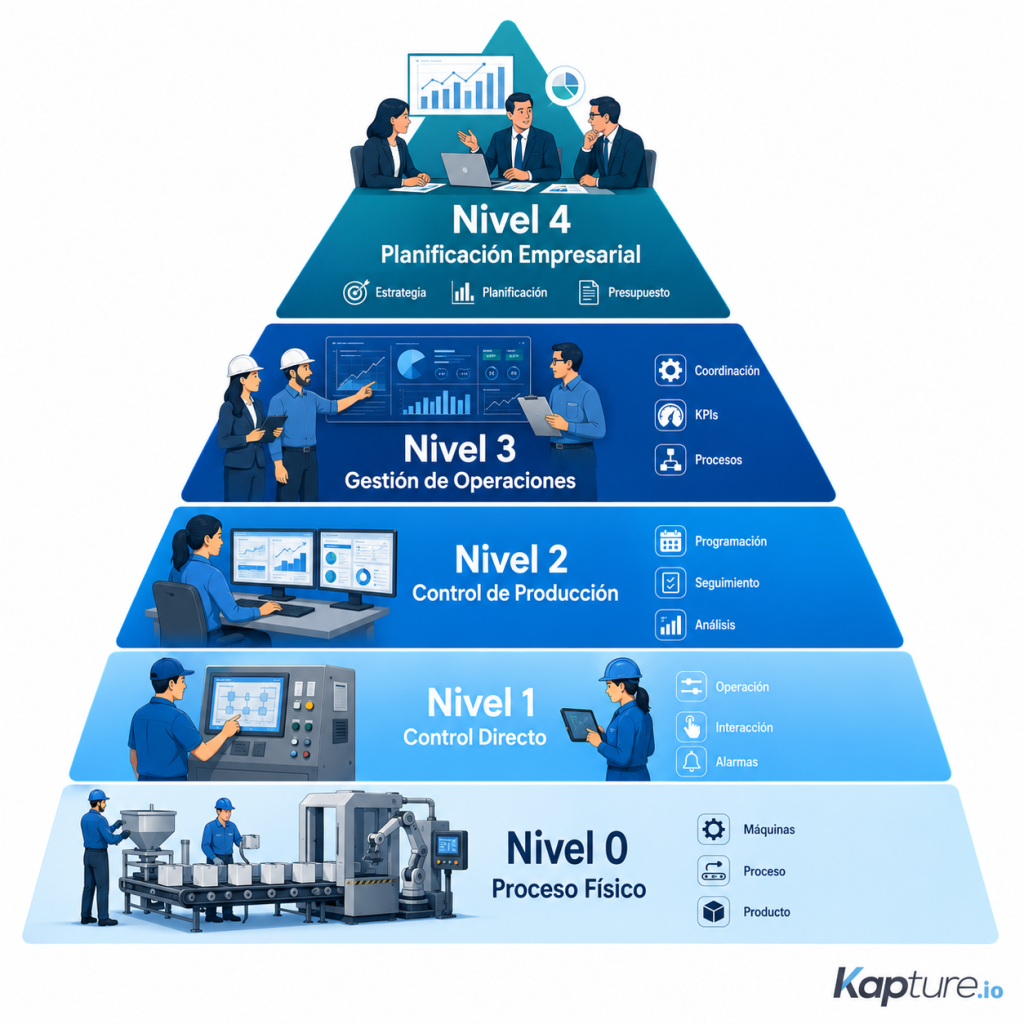
One of the most important aspects of ISA-95 is the definition of a clear industrial hierarchy. This hierarchy makes it possible to represent the plant’s structure from a functional and operational perspective.
In a manufacturing environment, it is not enough to know which product is being manufactured. It is also necessary to know where it is manufactured, in which area, with what resources, under what conditions, and with what associated controls. Therefore, a well-defined hierarchy is essential for linking information on production, quality, processes, and traceability.
Why ISA-95 Is Important for Industrial Quality
Quality management in manufacturing increasingly depends on the ability to link process data to controls, risks, technical documentation, and evidence of execution. In a traditional factory, quality may be managed using documents, spreadsheets, or disconnected systems. This can lead to problems such as:
- Difficulty in determining which control applies to each operation.
- Lack of traceability between parts, processes, and quality evidence.
- Duplicate data between production and quality.
- Technical documentation that is disconnected from actual implementation.
- Higher risk of manual errors.
- Less visibility into deviations and nonconformities.
- Slower and more complex audit processes.
ISA-95 helps overcome this isolated, document-based approach. It allows quality information to be linked to the actual manufacturing structure.
This means that a quality control measure does not exist merely as a document. It may be associated with a specific operation, a part, a production line, a product, a production order, or a specific process condition.
Benefits of Following the ISA-95 Standard
Adopting a model aligned with ISA-95 offers significant advantages for industrial companies and manufacturers seeking to scale up their digital transformation.
1. Standardization of Industrial Information
ISA-95 provides a common language for representing the factory. This reduces ambiguity and makes it easier for production, quality, engineering, and IT teams to work within the same framework.
2. Better integration between systems
An ISA-95-based model facilitates integration between ERP, MES, MOM, quality management systems, and data analytics platforms.
3. Greater traceability
By properly structuring the plant hierarchy, it is easier to determine where each operation was performed, what controls were applied, and what information is associated with each product or process.
4. Scalability
Industrial companies need systems that can grow with them. ISA-95 allows you to build a solid foundation for expanding functionality, integrating new processes, and adapting the solution to more complex plants.
5. Alignment with industry best practices
Major manufacturers of industrial software and MES/MOM solutions use ISA-95 as a standard for structuring factory data and facilitating integration between systems.
ISA-95 as the foundation for a robust industrial architecture
Compliance with ISA-95 is not just a technical matter. It is a way to ensure that the system is capable of representing the plant in an organized, scalable manner that is consistent with international best practices.
In our case, working with a hierarchy aligned with ISA-95 allows us to move toward a more comprehensive structure capable of linking processes, controls, quality documentation, projects, and parts within a single model.
This is especially important for integrating elements such as FMEA, control plans, and control guidelines, since all of them need to be linked to the actual manufacturing structure.

To summarize the above
ISA-95 is one of the most important international standards for factory digitization and the implementation of MES/MOM systems. Aligning the plant hierarchy with this standard improves traceability, facilitates integration between systems, and more accurately links production and quality information.
In an increasingly digitized industrial environment, following an ISA-95-based model helps build a more robust, scalable platform that is ready to meet the actual needs of the factory.
Content written by:
Xavier Conesa Foix, CGO of Kapture.io QMS
With more than 30 years dedicated to industrial quality improvement, Xavier combines technical expertise and strategic vision to transform quality control and incident management in the plant.


